if the price level rises, what will happen to the demand for reserves?
The Demand for Money
In economics, the demand for money is the desired holding of financial assets in the form of coin (cash or bank deposits).
Learning Objectives
Relate the level of the interest rate to the demand for money
Key Takeaways
Key Points
- Money provides liquidity which creates a trade-off between the liquidity advantage of holding coin and the interest advantage of belongings other assets.
- The quantity of money demanded varies inversely with the interest rate.
- While the demand of money involves the desired holding of financial assets, the money supply is the total corporeality of monetary assets available in an economy at a specific time.
- In the Us, the Federal Reserve Organization controls the coin supply. The Fed has the power to increase the coin supply by decreasing the reserve requirement.
Key Terms
- coin supply: The full amount of money (bills, coins, loans, credit, and other liquid instruments) in a particular economy.
- asset: Something or someone of any value; any portion of ane's belongings or effects so considered.
The Demand for Money
In economic science, the demand for coin is mostly equated with greenbacks or depository financial institution demand deposits. Mostly, the nominal demand for money increases with the level of nominal output and decreases with the nominal interest rate.
The equation for the demand for coin is: Md = P * 50(R,Y). This is the equivalent of stating that the nominal corporeality of money demanded (Md) equals the price level (P) times the liquidity preference function L(R,Y)–the amount of coin held in hands convertible sources (greenbacks, bank demand deposits). Specific to the liquidity function, Fifty(R,Y), R is the nominal interest rate and Y is the real output.
Money is necessary in gild to behave out transactions. Even so inherent to the holding of money is the merchandise-off between the liquidity advantage of holding coin and the interest advantage of holding other assets.
When the demand for money is stable, monetary policy tin help to stabilize an economy. However, when the need for coin is not stable, existent and nominal interest rates will modify and there will be economic fluctuations.
Touch on of the Interest Rate
The interest rate is the rate at which interest is paid by a borrower (debtor) for the utilise of money that they borrow from a lender (creditor). It is viewed as a "cost" of borrowing money. Interest-rate targets are a tool of monetary policy. The quantity of money demanded varies inversely with the interest rate. Central banks in countries tend to reduce the interest rate when they want to increment investment and consumption in the economy. Notwithstanding, depression interest rates can create an economic bubble where big amounts of investments are made, but upshot in big unpaid debts and economical crisis. The interest charge per unit is adjusted to keep aggrandizement, the need for money, and the wellness of the economy in a certain range. Capping or adjusting the interest charge per unit parallel with economic growth protects the momentum of the economy.
Control of the Money Supply
While the demand of money involves the desired property of financial assets, the money supply is the full amount of budgetary avails bachelor in an economy at a specific time. Data regarding money supply is recorded and published considering information technology affects the price level, inflation, the exchange charge per unit, and the business wheel.
Monetary policy also impacts the money supply. Expansionary policy increases the total supply of money in the economy more than rapidly than usual and contractionary policy expands the supply of coin more than slowly than normal. Expansionary policy is used to gainsay unemployment, while contractionary is used to slow inflation.
In the The states, the Federal Reserve System controls the coin supply. The reserves of money are kept in Federal Reserve accounts and U.South. banks. Reserves come from any source including the federal funds market place, deposits by the public, and borrowing from the Fed itself. The Fed tin attempt to change the money supply by affecting the reserve requirement and through other monetary policy tools.

Federal Funds Charge per unit: This graph shows the fluctuations in the federal funds charge per unit from 1954-2009. The Federal Reserve implements monetary policy through the federal funds rate.
Shifts in the Money Demand Curve
A shift in the money demand bend occurs when there is a alter in any non-price determinant of demand, resulting in a new need curve.
Learning Objectives
Explain factors that crusade shifts in the coin demand bend, Explain the implications of shifts in the money demand bend
Fundamental Takeaways
Key Points
- The real demand for money is defined as the nominal amount of money demanded divided past the price level.
- The nominal demand for money generally increases with the level of nominal output (the toll level multiplied past real output).
- The need for money shifts out when the nominal level of output increases.
- The demand for money is a result of the merchandise-off betwixt the liquidity advantage of belongings money and the interest advantage of holding other assets.
Key Terms
- nominal interest rate: The rate of interest before adjustment for inflation.
- asset: Something or someone of any value; whatever portion of ane's property or effects so considered.
Demand for Money
In economics, the demand for money is the desired belongings of financial avails in the form of money. The nominal demand for money by and large increases with the level of nominal output (the toll level multiplied past real output). The interest rate is the toll of money. The quantity of money demanded increases and decreases with the fluctuation of the interest rate. The real demand for money is defined as the nominal amount of money demanded divided past the cost level. A demand bend is used to graph and analyze the demand for money.
Factors that Crusade Demand to Shift
A demand curve has the price on the vertical axis (y) and the quantity on the horizontal centrality (x). The shift of the money demand curve occurs when there is a change in whatever non-price determinant of demand, resulting in a new demand curve. Non-toll determinants are changes crusade need to alter even if prices remain the same. Factors that influence prices include:
- Changes in dispensable income
- Changes in tastes and preferences
- Changes in expectations
- Changes in price of related goods
- Population size
Factors that change the need include:
- Subtract in the price of a substitute
- Increase in the price of a complement
- Subtract in consumer income if the good is a normal good
- Increment in consumer income if the expert is an junior good
The demand for money shifts out when the nominal level of output increases. It shifts in with the nominal involvement rate.
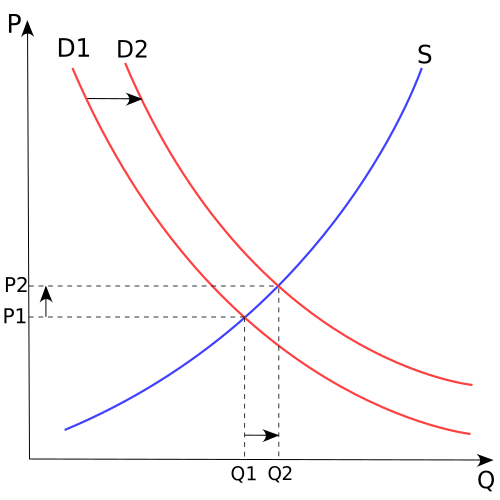
Shift of the Demand Curve: The graph shows both the supply and need curve, with quantity of coin on the 10-centrality (Q) and the price of coin as involvement rates on the y-centrality (P). When the quantity of money demanded increment, the price of money (involvement rates) as well increases, and causes the demand curve to increase and shift to the right. A decrease in demand would shift the curve to the left.
Implications of Demand Curve Shift
The need for money is a upshot of the trade-off between the liquidity reward of holding coin and the interest reward of belongings other assets. The demand for money determines how a person'due south wealth should be held. When the need curve shifts to the right and increases, the demand for money increases and individuals are more than likely to hold on to coin. The level of nominal output has increased and there is a liquidity reward in holding on to coin. Besides, when the demand curve shifts to the left, it shows a decrease in the need for money. The nominal interest rate declines and there is a greater interest advantage in holding other avails instead of coin.
The Equilibrium Interest Charge per unit
In a economy, equilibrium is reached when the supply of money is equal to the demand for money.
Learning Objectives
Employ the concept of market equilibrium to explain changes in the involvement charge per unit and money supply
Primal Takeaways
Fundamental Points
- The interest rate is the rate at which involvement is paid by a borrower (debtor) for the employ of money that they infringe from a lender (creditor).
- Factors that contribute to the involvement rate include: political gains, consumption, inflation expectations, investments and risks, liquidity, and taxes.
- In the case of coin supply, the market equilibrium exists where the interest rate and the money supply are balanced.
- The real interest rate measures the purchasing power of interest receipts. It is calculated by adjusting the nominal rate charge to have inflation into business relationship.
Key Terms
- equilibrium: The condition of a system in which competing influences are balanced, resulting in no net change.
- involvement rate: The percentage of an corporeality of money charged for its apply per some flow of fourth dimension (often a year).
Involvement Rate
The interest rate is the rate at which interest is paid past a borrower (debtor) for the use of money that they infringe from a lender (creditor). Equilibrium is reached when the supply of money is equal to the demand for money. Interest rates can be affected by monetary and fiscal policy, simply also by changes in the broader economy and the money supply.
Factors that Influence the Involvement Rate
Involvement rates fluctuate over time in the brusk-run and long-run. Within an economy, there are numerous factors that contribute to the level of the interest charge per unit:

Fluctuation in Interest Rates: This graph shows the fluctuation in interest rates in Germany from 1967 to 2003. Interest rates fluctuate over time as the result of numerous factors. In Federal republic of germany, the involvement rates dropped from xiv% in 1967 to nearly two% in 2003. This graph illustrates the fluctuations that can occur in the brusk-run and long-run. Involvement rates fluctuate based on sure economic factors.
- Political gain: both budgetary and fiscal policies can affect the coin supply and need for money.
- Consumption: the level of consumption (and changes in that level) affect the need for money.
- Aggrandizement expectations: inflation expectations affect a the willingness of lenders and borrowers to transact at a given interest rate. Changes in expectations will therefore touch the equilibrium involvement rate.
- Taxes: changes in the tax code touch the willingness of actors to invest or consume, which can therefore change the demand for money.
Marketplace Equilibrium
In economics, equilibrium is a state where economic forces such as supply and demand are counterbalanced and without external influences, the equilibrium volition stay the same. Market place equilibrium refers to a condition where a market price is established through competition where the amount of appurtenances and services sought by buyers is equal to the amount of goods and services produced by the sellers. In the case of money supply, the market equilibrium exists where the interest rate and the money supply are balanced. The money supply is the total amount of monetary avails available in an economy at a specific time. Without external influences, the interest charge per unit and the money supply will stay in balance.
washingtonjamet1970.blogspot.com
Source: https://courses.lumenlearning.com/boundless-economics/chapter/introduction-to-monetary-policy/
0 Response to "if the price level rises, what will happen to the demand for reserves?"
Postar um comentário